What makes a team?
Northern Trust’s design organization has gone through many iterations in the last 8 years. Moving from a centralized innovation shop to a decentralized integrated team is enough to give any organization whiplash.
Background
Since its inception in 2015, Northern Trust’s design organization has gone through many iterations, which was causing an identity crisis. Understanding what the design organization had to offer was difficult to understand, not only for our collaborators in the enterprise, but also for the team. We wondered how we could define the team we are now, and also let our partners in the enterprise know what types of craftspeople they can expect to find on the Experience Design and Research Team?
The Solution
Working closely with each of the capabilities inside Experience Design and Research, I was able to develop a set of 12 core competencies with demonstrated behaviors and an evaluation scale. These 12 competencies spanned all of our capabilities including data analytics, product design, design research, creative technology, and leadership.
Our core competencies became our guiding principles for other initiatives on our team such as interview guides and our team cards. Currently, we’re using these to guide how we build a balanced team and how we leverage it to build archetypes of the level we have at our organization.
Project Details
Team: Myself
My Role: Design Operations Lead
Time: 6 Weeks
In This Case Study
Overview
12 Competencies
Examples of Use
Process
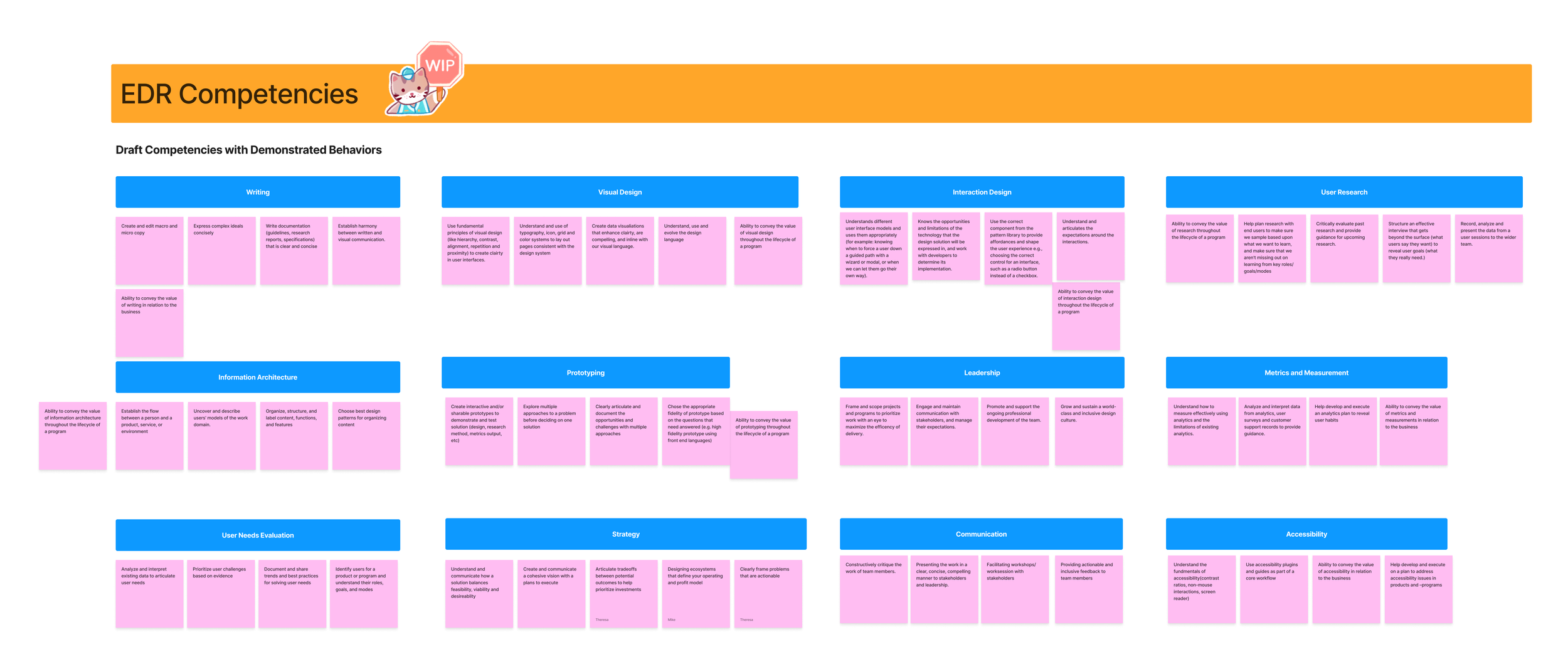
12 Core Competencies
Below are the 12 core competencies and sample of their demonstrated behaviors.
Accessibility
Understand the fundamentals of accessibility(contrast ratios, non-mouse interactions, screen reader)
Leadership
Frame and scope projects and programs to prioritize work with an eye to maximize the efficency of delivery.
User Needs Evaluation
Analyze and interpret existing data to articulate user needs.
Communication
Constructively critique the work of team members.
Metrics & Measurements
Understand how to measure effectively using analytics and the limitations of existing analytics.
User Research
Ability to convey the value of interaction design throughout the lifecycle of a program
Information Architecture
Ability to convey the value of information architecture throughout the lifecycle of a program
Prototyping
Choose Create interactive and/or sharable prototypes to demonstrate and test solutions, design patterns for organizing content
Visual Design
Use fundamental principles of visual design to create clarity in user interfaces.
Interaction Design
Understands different user interface models and uses them appropriately
Strategy
Understand and communicate how a solution balances feasibility, viability and desireablity
Writing
Create and edit macro and micro copy
How They Came to Life
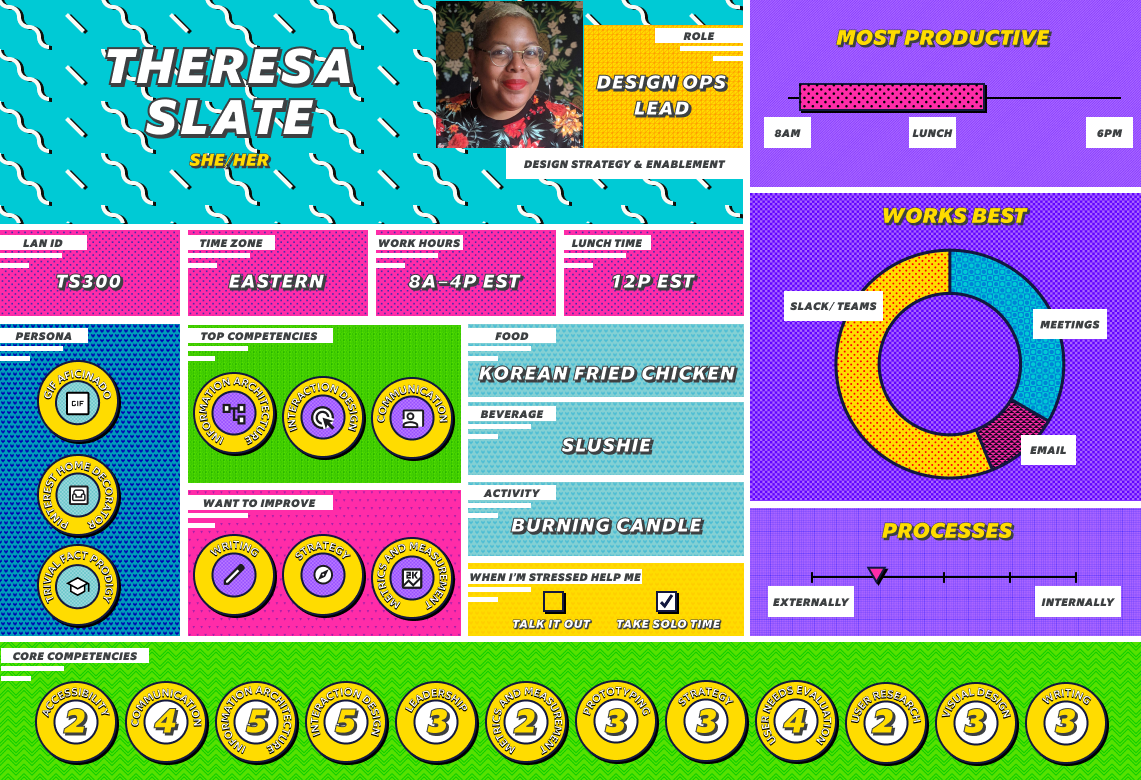
Portfolio Review Cheat Sheet
To help our team build a more balanced organization, we leveraged the core competencies to see where we were over and under indexed in skills on specific embedded teams and created an interview guide.
The guide focused on the 3 non-negotiable competencies and their level so we can be more objective in our hiring decisions. Once these were set, I created a set of behaviors to look for and sample questions to help evaluate the candidate across the competencies.
This guide was also translated into a figjam where members of the interview panel could take notes with quick access to the guide. The hiring manager then had a singular place to look for feedback from the team.
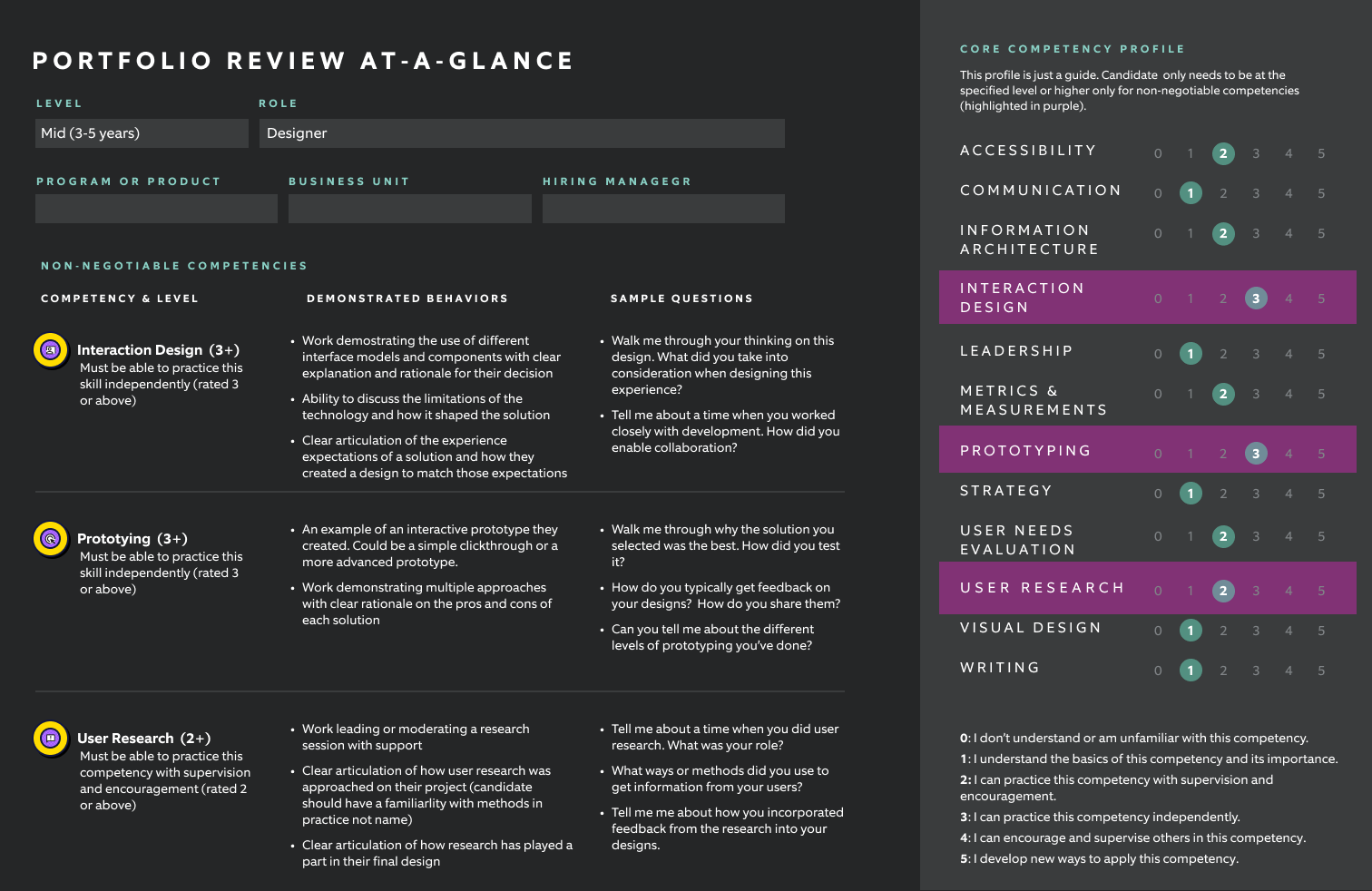
Team Cards
Our team had grown exponentially in 2020–2021 and a well timed inservice day gave me the opportunity to craft a new way for us to get to know each other. It would also allowed new people joining to take stock of the broader design organization.
The cards focused on basic information–name, pronouns, role, business unit and expanded into ways for us to engage one another outside of our work–personas(interests) and pick me ups (favorite things).
The Process
Virtual Workshops
I worked with each specific capability in Experience Design and Research–product design, design research experience insights (metrics) and design enablement. I led them through a series of exercises design to get each specific capability aligned around a rank ordered list of the top 3 competencies.
Group Elevator Pitch for Capability Definition
First, I had each capability work together to define itself. In this timed activity, we needed to distill down the essence of what each team does. This definition would serve as the grounding for everything we did in the workshop.
Individual Competency Drafts
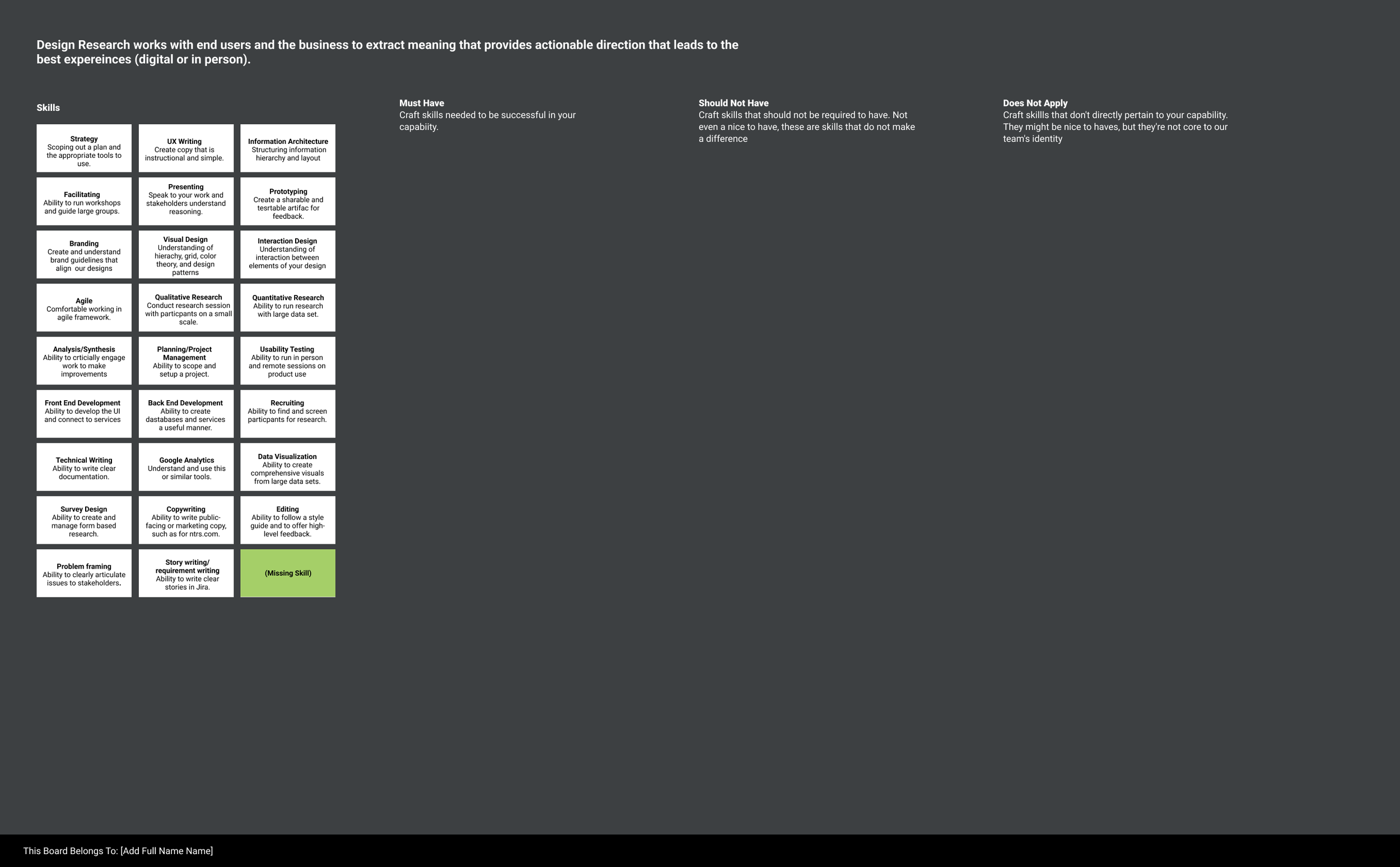
Next, I gave each person in the capability their own frame with a list of competencies. They each had 10 minutes to draft each competency into one three categories:
Must Have: Competencies that are core to who we are as a capability and are required to be successful in the role
Nice to Haves: Skills that would be beneficial in this capability, but aren’t required
Must Not Have: Skills that have no bearing on your success in this capability.
Each member of the team shared out their list and rationale for including specific competencies in must have.
Team Competency Drafts
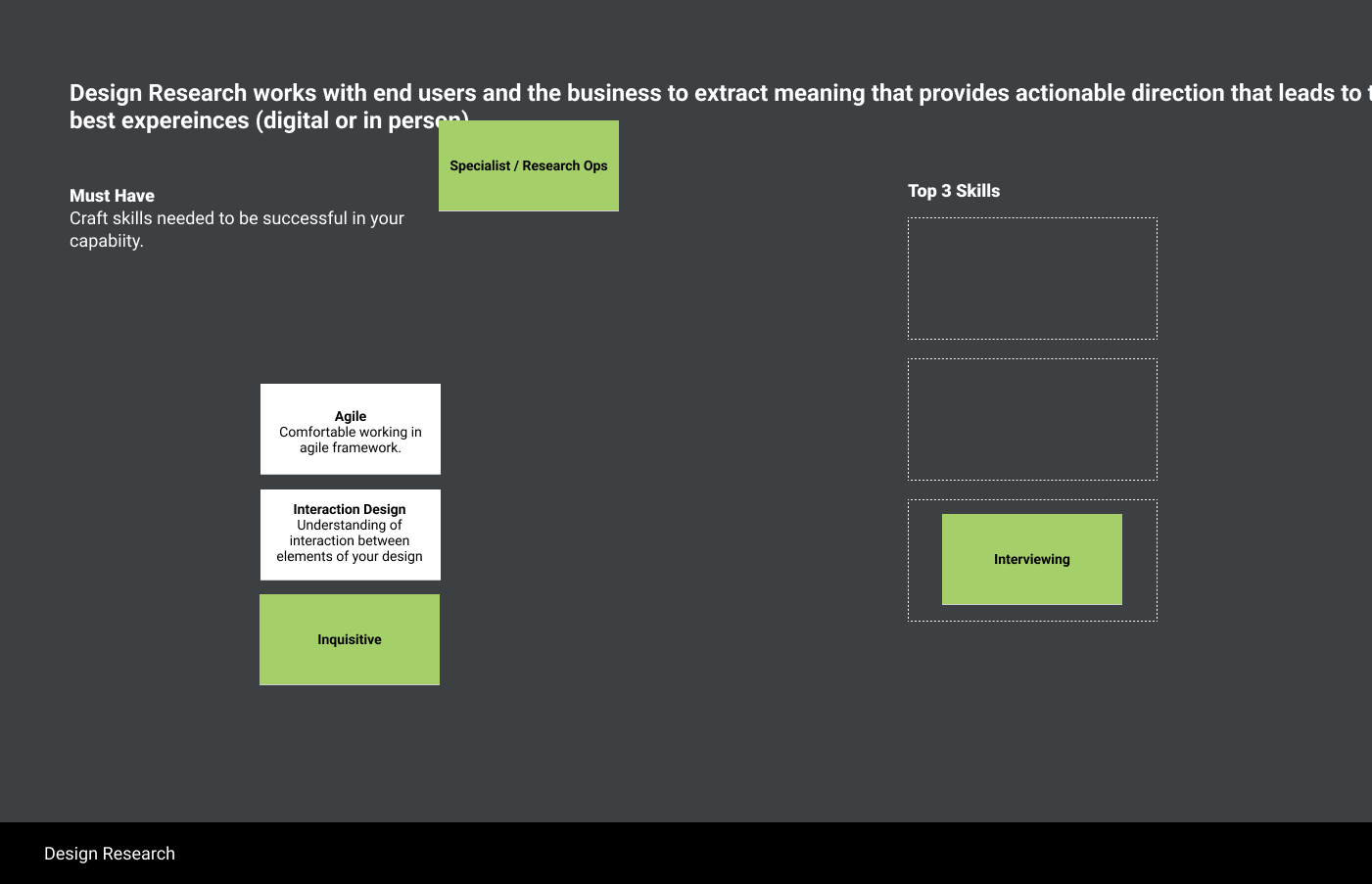
During a break I took all of the individual drafts, and pulled the overlapping must haves into a new page. Any overlapping nice to haves were moved to the left of the frame to allow anyone to advocate for a nice to have to become a must have.
This is where the group worked together to come up with a rank ordered list of the top three competencies critical to their capability. I facilitated this discussion with the following questions:
How would you define this competency? Why is it important for your capability?
Is this a competency that is unique to your capability, or is it something that is table stakes for any member of the Experience Design and Research Team?
Is this a competency your capability is committed to building, or is this a competency you expect to already be at a high level before joining the team?
The questions were a forcing function to help us root out some of the people skills that are more applicable to anyone in our organization (e.g. Leadership, Communication, etc). So, the team to really reflect on their craft and discuss what was important for a craftsperson joining the capability.
Overlap & Initial List
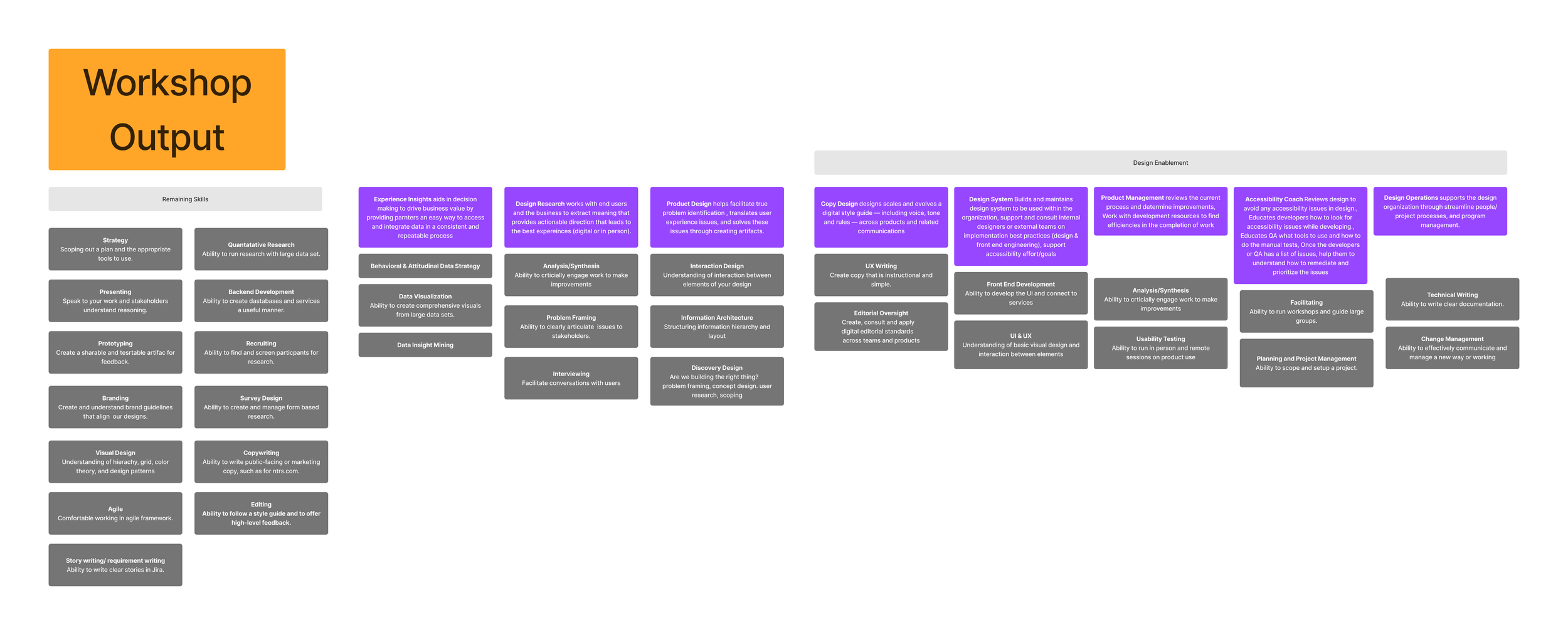
After running the workshop with all four of our capabilities, we had an initial list of competencies that was way too large to be meaningful. I presented these initial findings to the Senior Leadership team.
Refined List
Going back to the artifacts I had created with the teams in Figma, I worked with the senior leadership team to get us down to a refined set of competencies that is a reflection of where our team currently stands and aspirational for where we want to go in to the future.